Manual memory Memes

Posts tagged with Manual memory
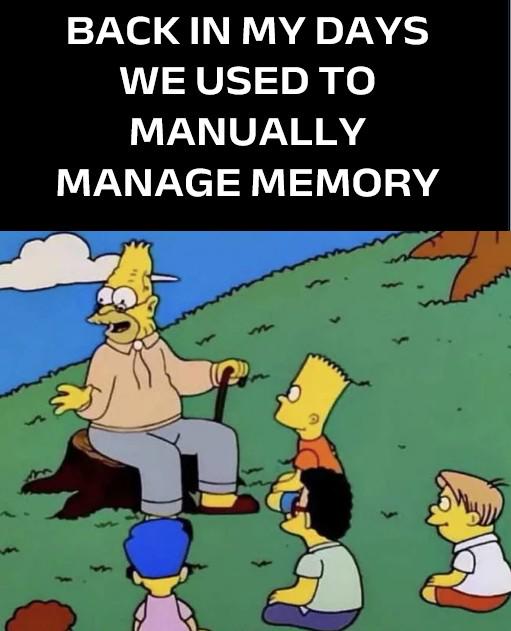
Full Control Over Memory

Full Control Over Memory
Old-timer C/C++ devs telling war stories about malloc(), free(), and pointer arithmetic like they survived some ancient apocalypse. Meanwhile, the younger generation is sitting there with their garbage collectors and automatic memory management, wondering why anyone would willingly sign up for segmentation faults at 3 AM. The grandpa energy is strong with this one. "Full control" is just a fancy way of saying "full responsibility for every byte you touch, and if you mess up, enjoy your memory leaks and undefined behavior." Sure, you get performance and precision, but at what cost? Your sanity and a debugger permanently open in another window. Modern languages basically said "nah, we're good" and automated the whole thing. But there's still something oddly nostalgic about manually tracking every allocation like some kind of memory accountant.

Teaching Your Kids About Languages

Teaching Your Kids About Languages
Parent explains the beautiful concept of garbage collection to their child, showing them the enlightened path of modern memory management. Kid innocently asks about that dark, mysterious land in the distance. "That's C++, child. We don't speak of that place." Manual memory management is the forbidden zone where pointers roam free and segfaults lurk behind every corner. Some say developers who venture there never return the same. Others just return null.

The Duality Of New

The Duality Of New
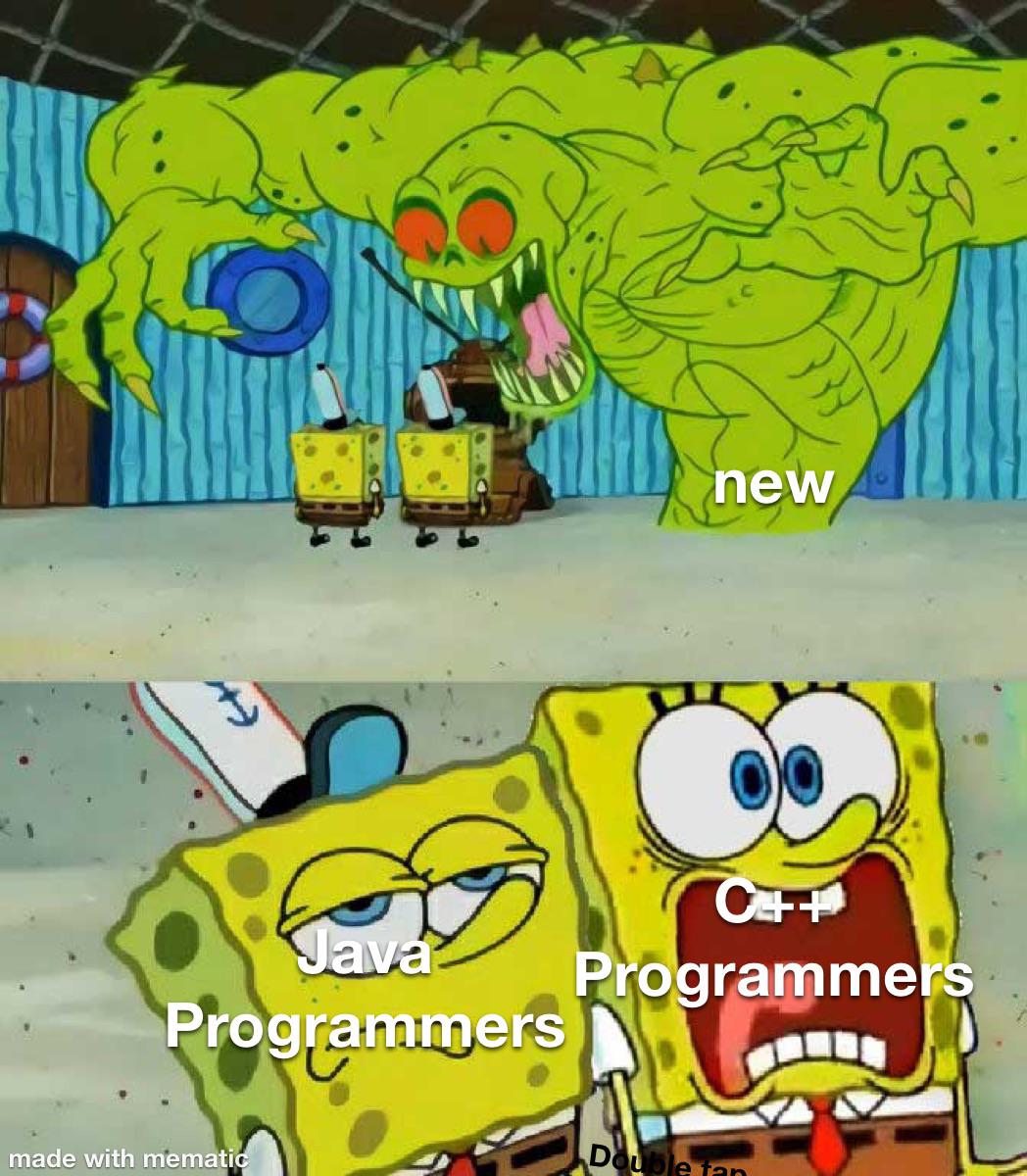
The new keyword: either your best friend or your worst nightmare depending on which language you're writing. Java devs see new and just shrug—it's Tuesday, time to instantiate another object. Meanwhile, C++ programmers see new and immediately start sweating because they know they're now personally responsible for calling delete later, or face the wrath of memory leaks that'll haunt their production servers like a digital poltergeist. Java's got that garbage collector doing all the heavy lifting, so new is just another Tuesday. But in C++? You're playing memory management on hard mode with no safety net. One forgotten delete and you're debugging segfaults at 2 AM wondering why your program ate 47GB of RAM.

I Like C

I Like C
C programmers when asked to justify their language choice: "I admire its purity." Translation: I enjoy manually managing memory, dealing with buffer overflows, and having zero safety nets because apparently abstractions are for the weak. The "survivor, unclouded by conscience, remorse, or delusions of morality" bit hits different when you realize C devs have written so much unsafe code that they've transcended guilt entirely. No garbage collector? No problem. Segfault at runtime? Just another Tuesday. They're basically battle-hardened veterans who've seen things—terrible things—in the stack and heap, and they've emerged with a thousand-yard stare and an unshakable devotion to pointers.

Memory Unsafe Language Things

Memory Unsafe Language Things
Oh look, it's C and C++ programmers literally worshipping at the altar of malloc() like it's some ancient deity that demands blood sacrifices! And honestly? It kinda does. Every time you call malloc without its equally temperamental partner free() , you're basically throwing your memory into the eternal void of memory leaks. The dramatic biblical imagery is *chef's kiss* because managing memory manually IS a religious experience—full of faith, hope, and the constant terror that you've accidentally summoned a segmentation fault demon. Meanwhile, the Rust and garbage-collected language folks are watching this ritual from a safe distance, sipping their memory-safe lattes.

Escaping Pointer Prison

Escaping Pointer Prison
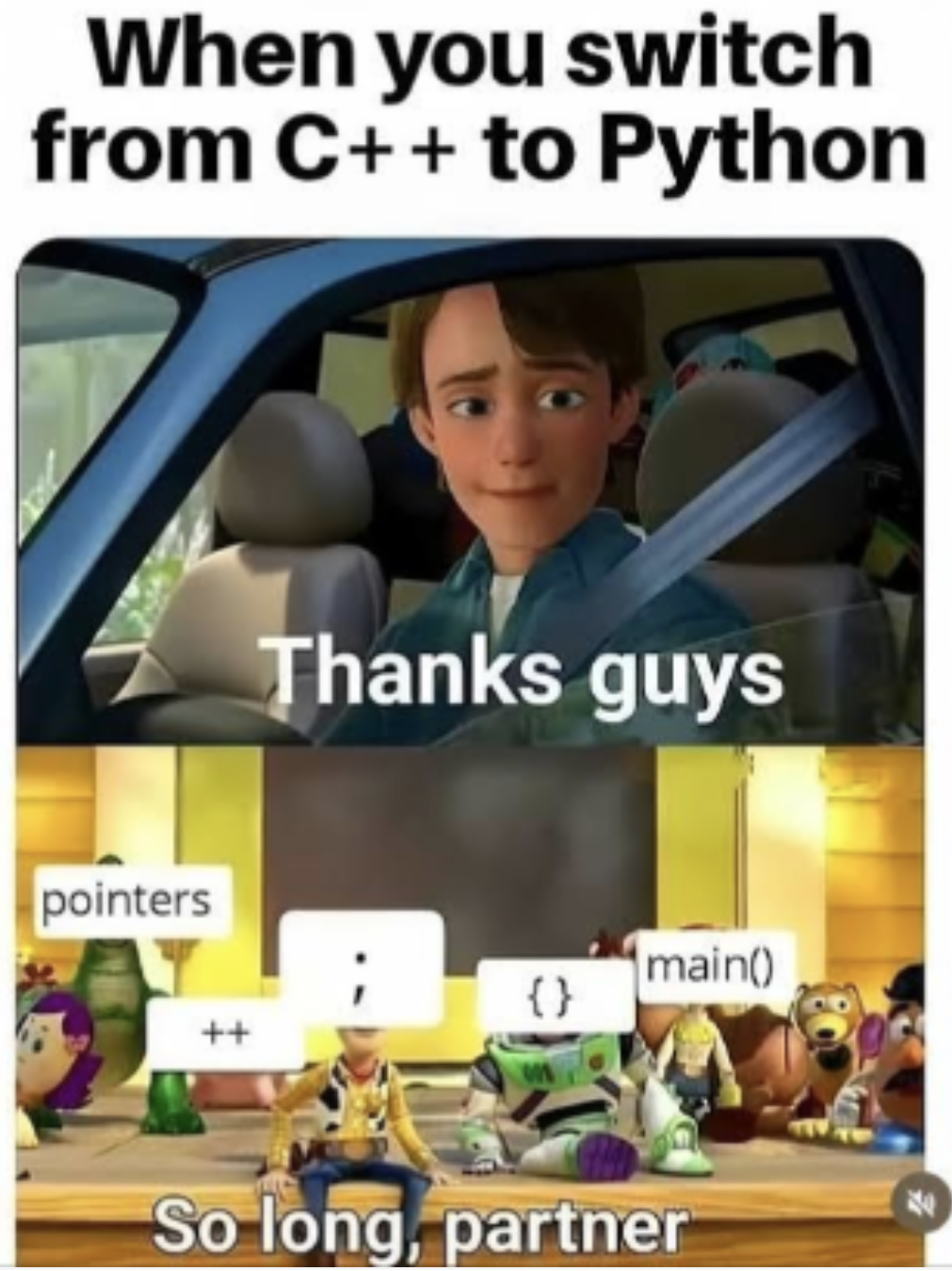
After years of manually managing memory, chasing segfaults at 3 AM, and debugging double-free errors that make you question your life choices, switching to Python feels like being released from prison. You wave goodbye to pointers, the increment operator, semicolons, curly braces, and that cursed main() function like they're toxic exes you never want to see again. The garbage collector becomes your new best friend. No more malloc/free dance routines. Just pure, blissful automatic memory management. Sure, Python might be slower, but at least your code won't randomly crash because you dereferenced a null pointer or forgot to delete something. Freedom never felt so interpreted.

Why Is There A Memory Leak

Why Is There A Memory Leak
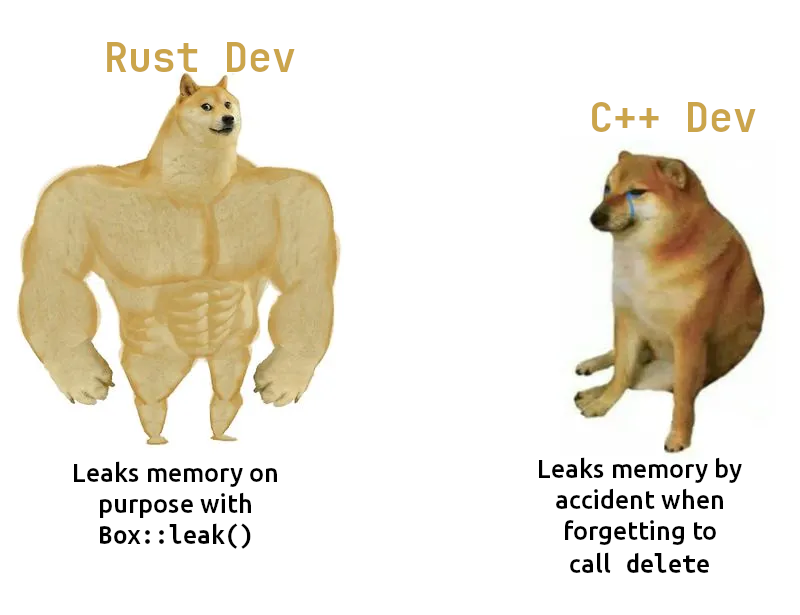
The chad Rust developer intentionally leaks memory using Box::leak() because they're so confident in their memory management skills that they can afford to do it on purpose. Meanwhile, the C++ developer is crying in the corner because they forgot to call delete for the 47th time today and now Valgrind is screaming at them. The beauty here is that Rust's borrow checker is so strict that when you actually need to leak memory (for static lifetime shenanigans or FFI), there's a dedicated function for it. C++ just lets you shoot yourself in the foot by accident while you're trying to tie your shoes. One is a calculated power move, the other is a Tuesday afternoon debugging session that ends at 2 AM.

JOY worker Standing Desk Converter, 32" Height Adjustable Sit Stand Riser

JOY worker Standing Desk Converter, 32" Height Adjustable Sit Stand Riser
Desk Riser for Instant Sitting to Standing: Standing desk converter allows you to elevate your workstation from 4.9” to 19.3” smoothly in seconds, simply squeeze the handle and lift your tabletop to …

In A While, Pointer Pile

In A While, Pointer Pile
When you forget to free your memory in C/C++, the garbage collector doesn't come to save you—it's just you and your memory leaks in the wild west of manual memory management. The figure is having an existential crisis over leaking a memory reference, while the demonic "WHEEZE" face is cackling "See ya later, allocator!" because that memory is now lost forever in the heap. It's like forgetting to close the fridge door, but instead of spoiled milk, you get a slowly dying application that your users will absolutely blame you for.

We Are Fine

We Are Fine
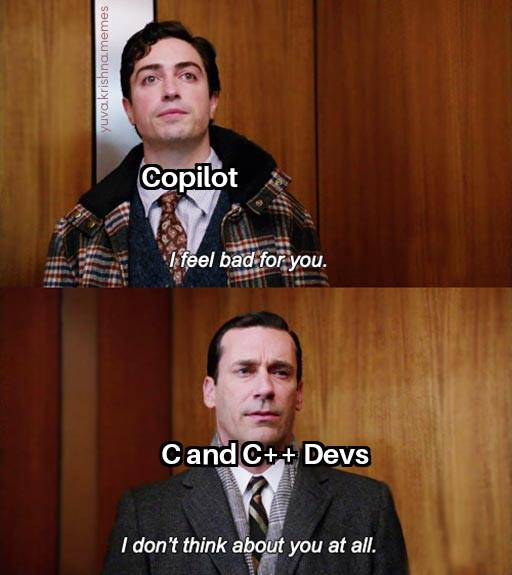
GitHub Copilot looking down at C and C++ developers with fake sympathy while they continue to manually manage memory like it's 1972! The absolute AUDACITY of AI to pity us mere mortals who still allocate and free our own bytes like barbarians! Meanwhile, C++ devs are just there with their pointers and manual garbage collection, completely unbothered by the AI revolution, too busy fighting with segmentation faults to even notice they're being condescended to. The relationship between cutting-edge AI and old-school programming is giving me SERIOUS trust fund kid meets blue-collar worker vibes!

Average C++ Developer

Average C++ Developer
Behold the C++ developer in their natural habitat: manually managing memory while flexing on "easier" languages. These magnificent creatures believe that if you're not wrestling with pointers and segmentation faults before breakfast, you're not really programming. They've built biceps from carrying the weight of all those header files and abs from tensing up every time they forget to delete what they malloc'd. Modern languages with garbage collection? That's for the weak. Real programmers prefer their languages like they prefer their coffee—unnecessarily complex and likely to keep you up at night debugging.