Simd Memes

Posts tagged with Simd

Pushufb My Beloved

Pushufb My Beloved
You know you've reached peak nerd status when the AMD64 Architecture Programmer's Manual Volume 4 on 128-bit and 256-bit media instructions is your idea of a perfect gift. Nothing says "I love you" quite like SIMD instruction documentation. For context: these are the arcane scrolls that document instructions like pushufb (hence the title), which lets you shuffle bytes around in registers like you're playing card tricks with your CPU. It's the kind of low-level optimization porn that makes systems programmers weak in the knees. The real joke? Someone out there genuinely gets this excited about instruction set architecture manuals. They exist. They walk among us. They probably optimize their breakfast routine using vectorized operations.

700 Lines Of AVX2 Infrastructure To Sum An Array Of Integers

700 Lines Of AVX2 Infrastructure To Sum An Array Of Integers
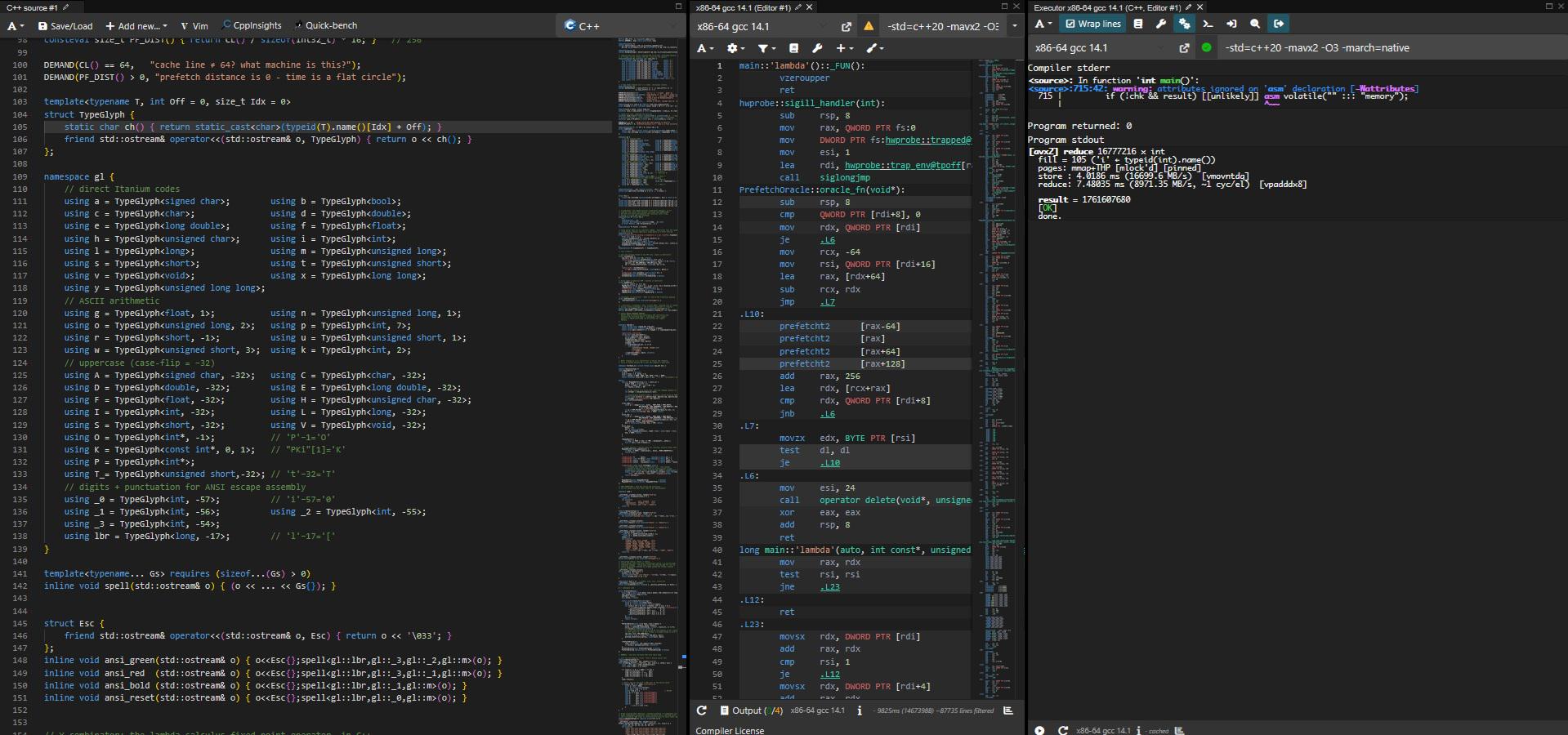
So you decided to optimize your integer sum using SIMD instructions and AVX2 because that for loop was just too slow . Now you've got 700 lines of TypeGlyph typedef hell, unsigned chars, signed shorts, doubles, floats, and enough template boilerplate to make even Bjarne Stroustrup weep. Meanwhile, the compiler's auto-vectorization would've done this in like 3 lines. But sure, let's manually manage SIMD registers and pretend we're writing assembly because we're "performance engineers." The kicker? Your elaborate AVX2 masterpiece probably runs 2% faster than the naive implementation, but now nobody on your team can maintain it. Worth it? Absolutely not. Will you do it again? Absolutely yes. Fun fact: AVX2 (Advanced Vector Extensions 2) lets you process 256 bits of data at once, which sounds impressive until you realize you spent 40 hours debugging alignment issues to save 3 milliseconds.

Parallel Computing Is An Addiction

Parallel Computing Is An Addiction
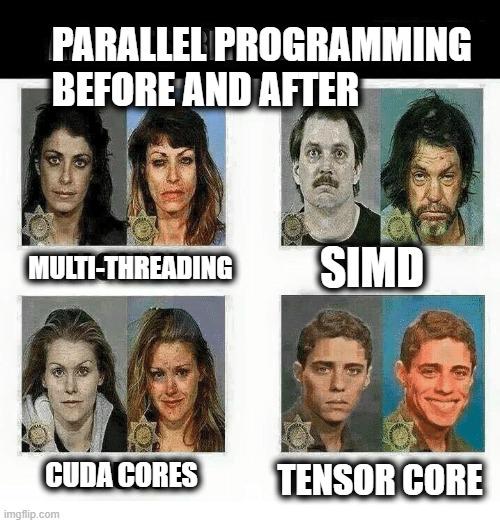
Multi-threading leaves you looking rough around the edges—classic race conditions and deadlocks will do that. SIMD hits even harder with those vectorization headaches. CUDA cores? You're barely holding it together after debugging memory transfers between host and device. But Tensor cores? You're grinning like an idiot because your matrix multiplications just became absurdly fast and you finally feel alive again. Each level of parallel computing optimization takes a piece of your soul, but the performance gains are too good to quit. You start with simple threading, then you're chasing SIMD instructions, next thing you know you're writing CUDA kernels at 2 AM, and before long you're restructuring everything for tensor operations. The descent into madness has never been so well-optimized.