Game industry Memes

Posts tagged with Game industry
Indie Vs AA Vs AAA

Indie Vs AA Vs AAA
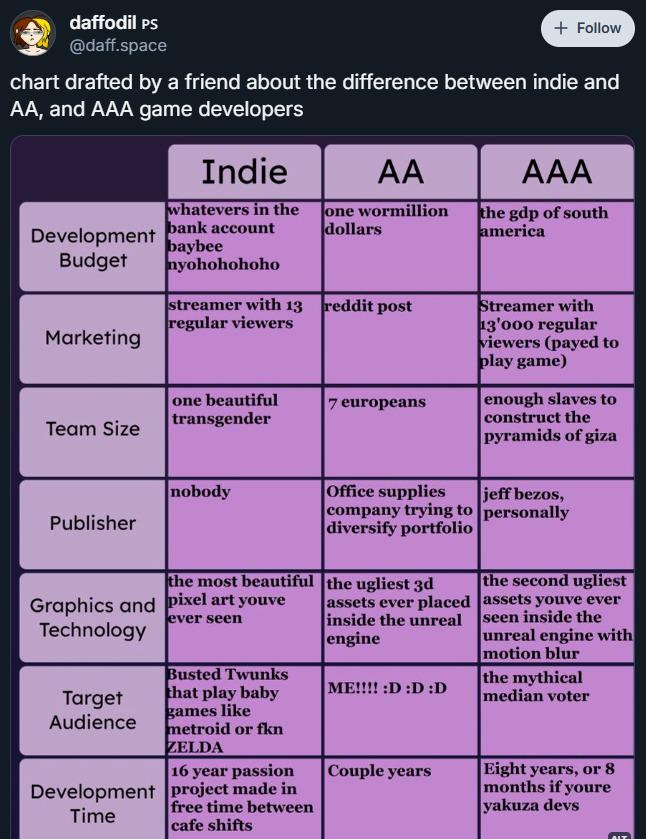
The brutal reality of game development, laid out in a handy comparison chart. Indie devs survive on whatever coins fell behind the couch cushions and their marketing strategy is basically "please notice me senpai" to a Twitch streamer with 13 viewers. Their team? One overworked soul who's simultaneously the programmer, artist, composer, and therapist. AA studios have that sweet spot of "one wormillion dollars" (not enough) with marketing that's just... a Reddit post. Seven Europeans somehow build games that punch way above their weight class, but their graphics look like they hired the Unreal Engine asset store's clearance section. AAA? They've got the GDP of a small nation, pay streamers more than most devs make in a year, and have enough staff to rebuild ancient wonders. Their publisher is literally Jeff Bezos, and their target audience is "the mythical median voter" - aka everyone and no one. Development time is either 8 years or 8 months depending on whether Yakuza Studio is involved. And yes, those graphics still look like trash despite the motion blur covering everything. The development time comparison hits different though - 16 years of passion between cafe shifts vs "8 months if you're Yakuza Studio" is chef's kiss accuracy.

Job Ads

Job Ads
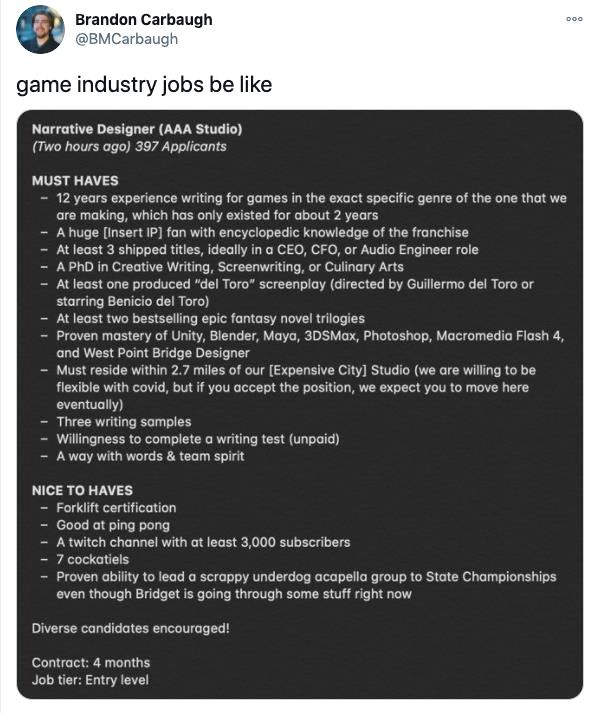
Game industry recruiters really said "let's ask for the entire Marvel Cinematic Universe worth of experience" and then slapped "Entry Level" on a 4-month contract. Because nothing screams "entry level" like needing to be a bestselling novelist, Unity master, del Toro collaborator, AND having the social skills to lead an acapella group while living within 2.7 miles of their office. The "Nice to Haves" section is particularly chef's kiss—forklift certification and ping pong skills are apparently equivalent qualifications. Also love how they want someone with 12 years of experience in a genre that's existed for 2 years, plus encyclopedic knowledge of a franchise they won't even name. Very reasonable. And after demanding you be a polymath Renaissance person who moonlights as a Twitch streamer with 3,000 subscribers, they'll generously pay you for 4 months before ghosting you. But hey, diverse candidates encouraged! Nothing says "we value diversity" like requirements that would make Leonardo da Vinci feel underqualified. 397 applicants already applied btw. The bar is on the floor, yet somehow also in orbit.

I Feel For People... But Starfield Was Not A Result That Keeps Jobs

I Feel For People... But Starfield Was Not A Result That Keeps Jobs
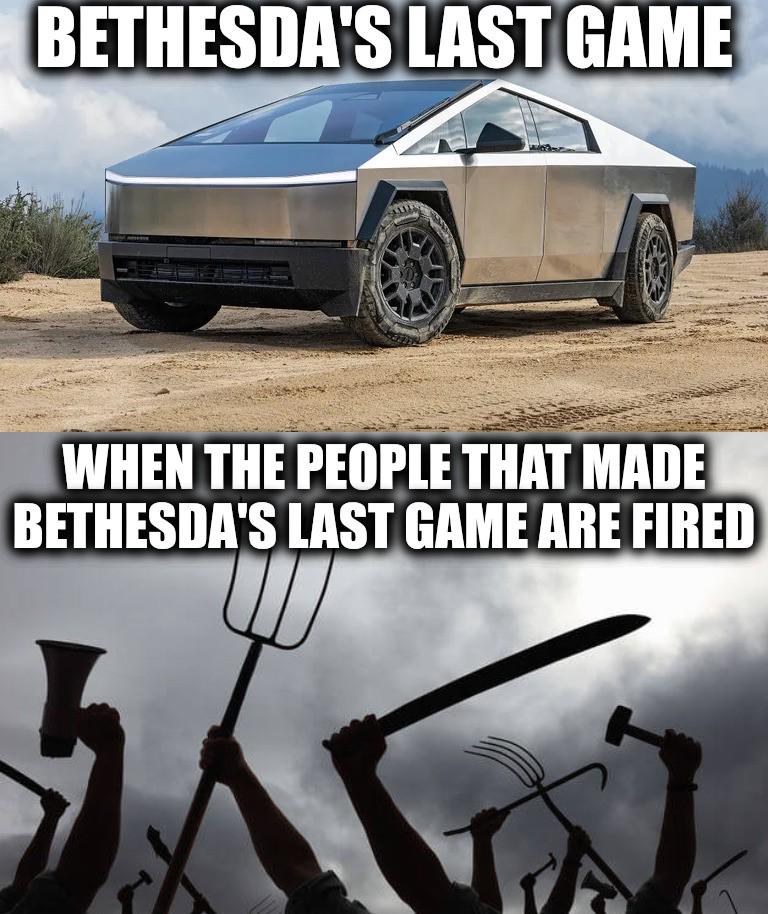
Oh man, the Cybertruck representing Bethesda's latest game is absolutely brutal. You ship a product that looks futuristic on paper but ends up being a polarizing disaster with questionable design choices, performance issues, and a community that's more disappointed than hyped. Then when layoffs hit, the devs who worked on that underwhelming title are the first to go. It's the harsh reality of game dev: you're only as safe as your last shipped product's Metacritic score. Starfield promised infinite procedurally-generated planets but delivered infinite procedurally-generated disappointment. Now those same devs are getting procedurally-generated pink slips. The pitchforks are out because shipping a Cybertruck when people expected a Tesla Model S doesn't exactly inspire executive confidence in job security. Brutal, but that's the industry.

When Did This Become The Standard?

When Did This Become The Standard?
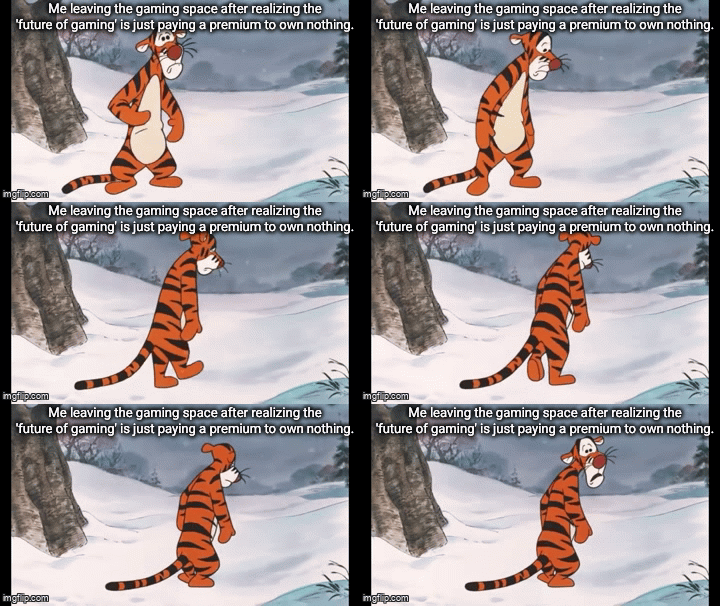
Remember when you just bought a game and... owned it? Wild concept, I know. Now you're basically renting everything with a side of microtransactions, season passes, and battle passes. The "future of gaming" turned out to be paying $70 upfront for the privilege of paying more later. It's like buying a car but the steering wheel is DLC and the radio requires a monthly subscription. Game devs went from "here's a complete product" to "here's 60% of a product, the rest is in our premium store." Even single-player games now have online requirements and microtransactions. The gaming industry looked at subscription models and said "yes, but make it worse."

This Is The End

This Is The End
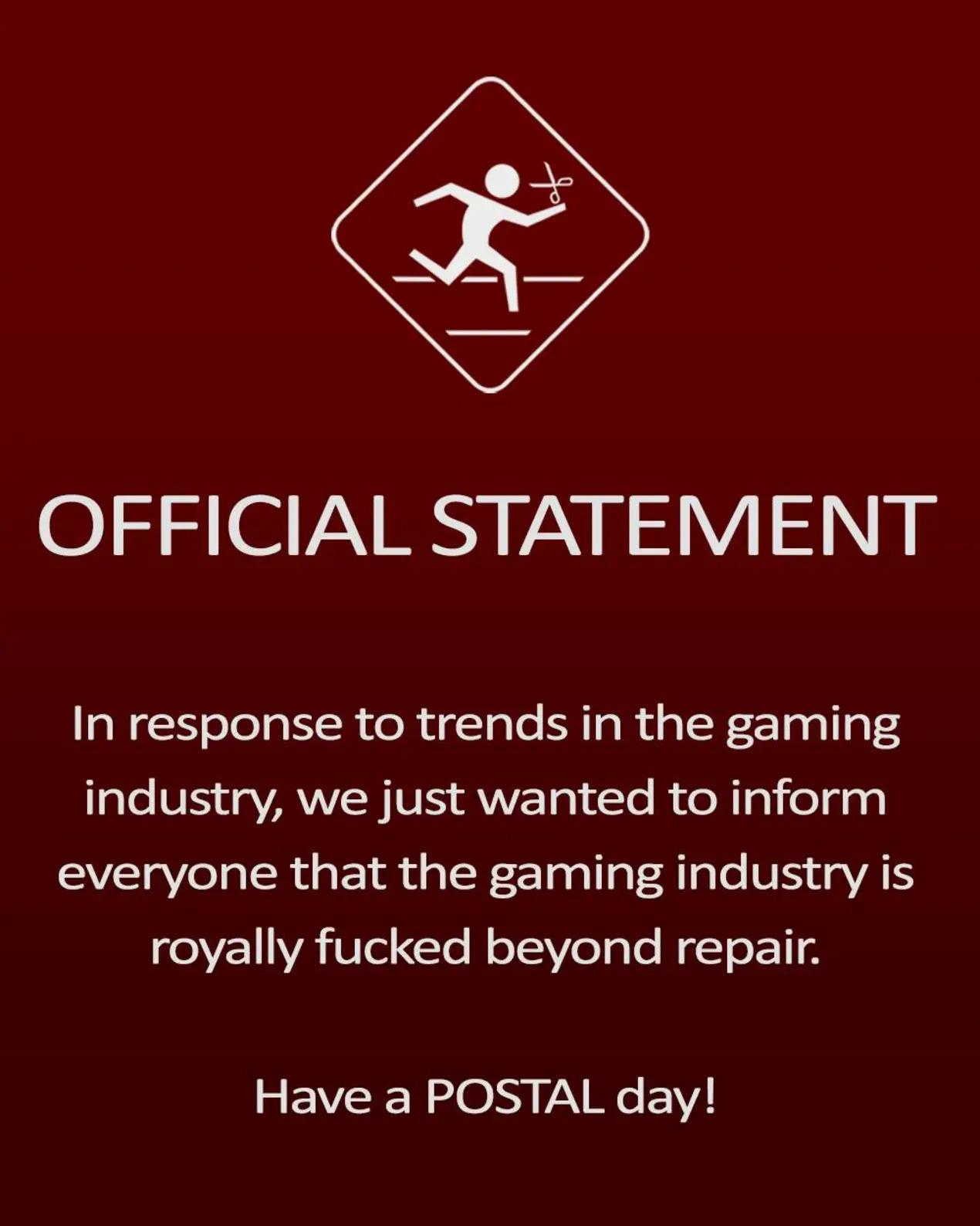
Someone finally said what we were all thinking. The gaming industry has gone full postal—and not the fun 90s game kind. Between predatory microtransactions, unfinished releases, day-one patches that are bigger than the game itself, and studios treating developers like disposable NPCs, the whole sector has achieved what we in tech call "catastrophic failure mode." The sign showing a stick figure getting absolutely wrecked is the perfect visual metaphor. That's basically every game dev after their 80-hour crunch week, every player who paid $70 for a beta test, and every QA engineer whose bug reports got ignored until launch day. The "Have a POSTAL day!" sign-off is chef's kiss—maintaining corporate pleasantries while announcing the apocalypse. It's like ending a 500 error page with "Thanks for your patience!" Nobody's having a good day here.

025 Gits Pink Bumper Sticker Window Vinyl Decal 5"

025 Gits Pink Bumper Sticker Window Vinyl Decal 5"

This'll Work, Trust Me Bungie, I Have A High School Diploma

This'll Work, Trust Me Bungie, I Have A High School Diploma
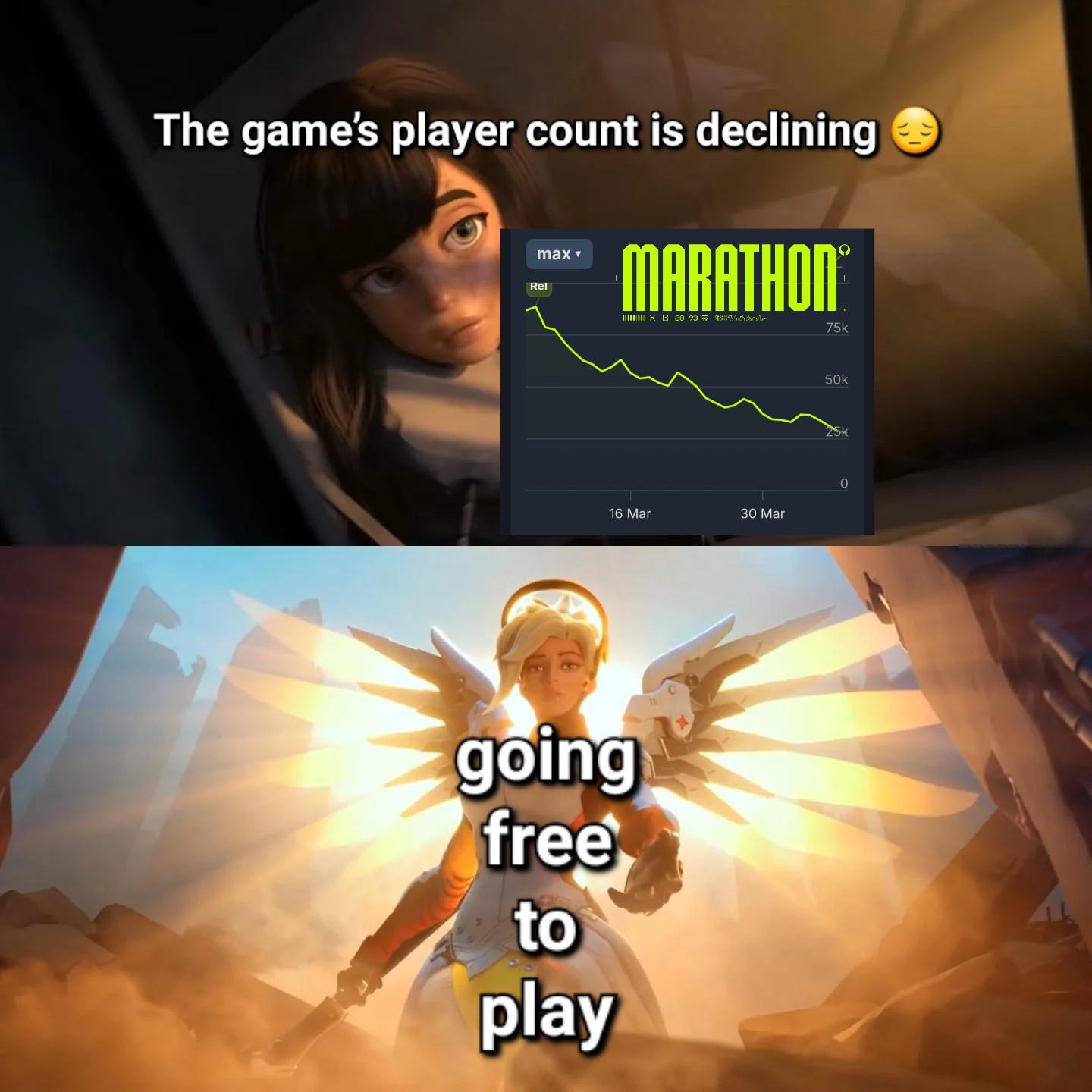
Nothing screams "sustainable business model" quite like watching your player base hemorrhage while some MBA genius decides the solution is making the game free-to-play. Because when your product is dying, the obvious move is to stop charging for it, right? The graph shows Marathon's player count dropping from 75k to basically zero in two weeks—that's not a decline, that's a cliff dive. And the brilliant strategy? "Let's give it away for free!" Sure, that'll totally fix the core issues that made people leave in the first place. It's like putting a "FREE" sign on a sinking ship. This is what happens when business decisions override actual game development. Your game isn't bleeding players because of the price tag—it's bleeding players because something is fundamentally broken. But hey, at least the quarterly earnings call will have a nice spike in "user acquisition" before everyone realizes free garbage is still garbage.

The AAA Industry Seems Broken Beyond Repair

The AAA Industry Seems Broken Beyond Repair
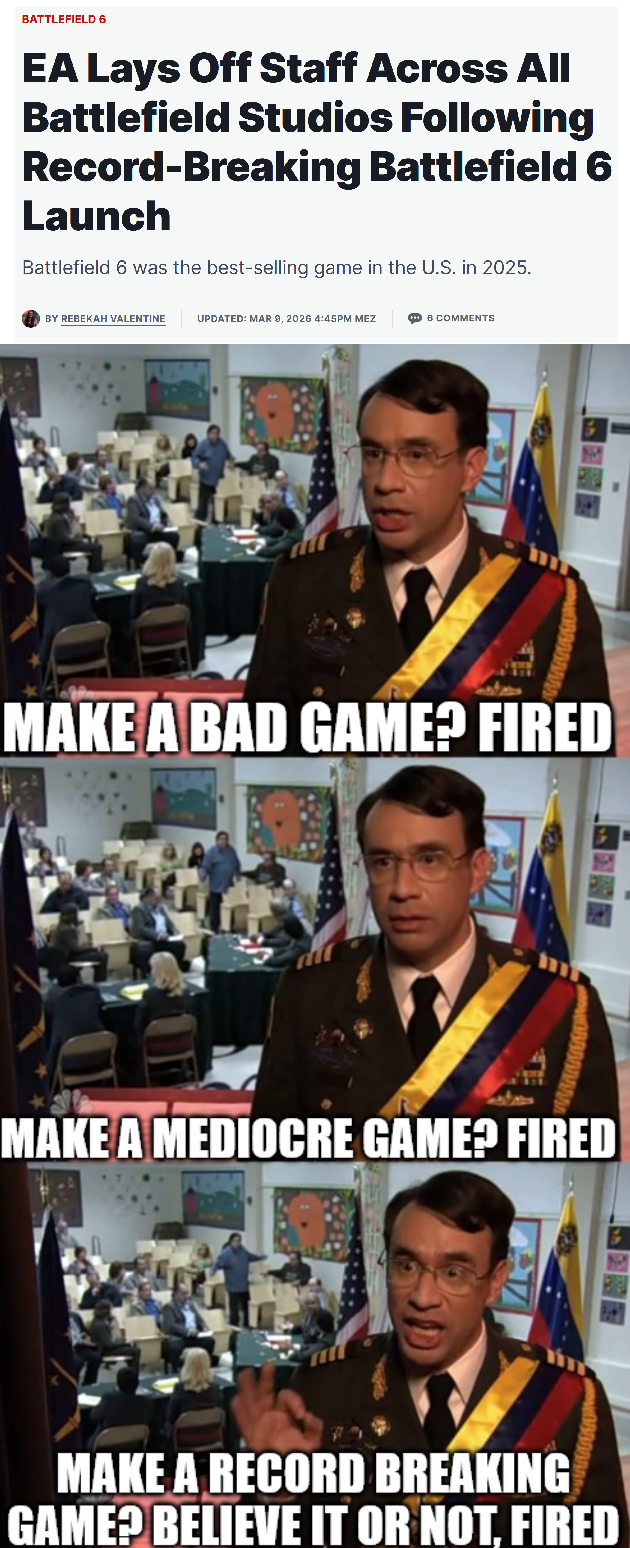
Triple-A game studios have perfected the art of failing upward. Ship a buggy mess? Fired. Ship something merely forgettable? Also fired. But somehow deliver a record-breaking bestseller that prints money? Believe it or not, straight to the unemployment line. The logic here is absolutely bulletproof: why keep the talented devs who just made you billions when you could pocket that money and hire cheaper replacements for the next inevitable disaster? It's like deleting your production database after a successful deployment because "we don't need it anymore." Welcome to modern game dev, where success is punished harder than failure because shareholders need their quarterly sacrifice. The beatings will continue until morale improves—oh wait, we laid off morale last quarter.

Its A Refreshing Change Of Other Companys

Its A Refreshing Change Of Other Companys
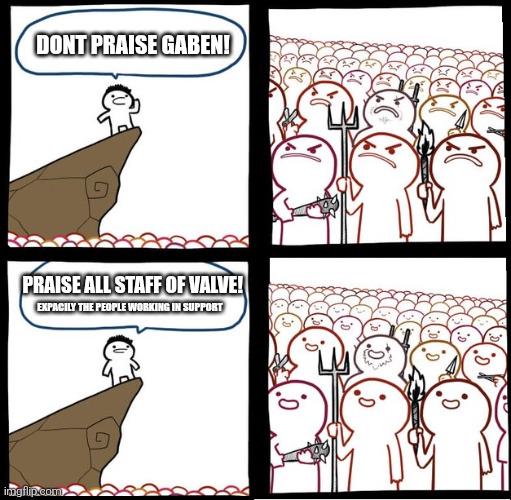
You know you're living in a dystopian tech world when praising literally everyone on the team gets you a standing ovation. Gaben and Valve have somehow cracked the code: treat your employees like humans, let them work on what they want, ship games when they're ready (Half-Life 3 notwithstanding), and don't crunch people into the ground. Meanwhile, the rest of the industry is out here with mandatory 80-hour weeks, layoffs after record profits, and CEOs taking home bonuses that could fund an indie studio for a decade. The bar is literally on the floor, and Valve just casually stepped over it while everyone else is doing limbo underneath. Support staff getting recognition? Revolutionary. Not treating devs like disposable code monkeys? Groundbreaking. It's wild that basic human decency in game dev is now considered a flex.

And People Wonder Why Indie Games Are So Beloved These Days Over AAA

And People Wonder Why Indie Games Are So Beloved These Days Over AAA
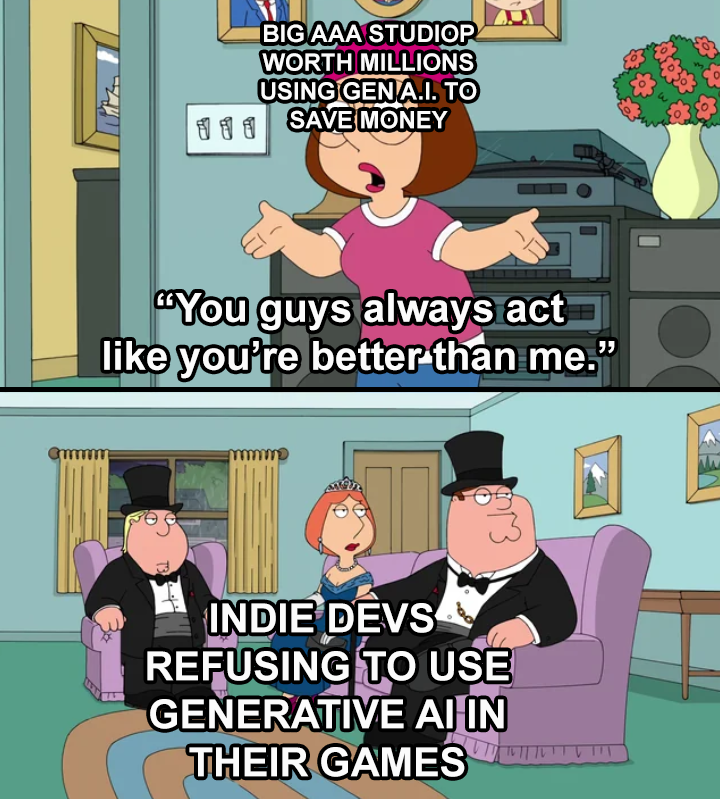
Big AAA studios with infinite budgets slapping AI into everything to "save money" while indie devs are out here actually crafting games with passion and soul. The irony? The billion-dollar companies are cutting corners with generative AI while the solo dev eating ramen in their apartment is hand-crafting every pixel. It's like watching a Michelin-star restaurant serve microwave dinners while the food truck down the street is making everything from scratch. And then the AAA studios wonder why players prefer the indie games that actually feel like someone cared about making them.

No 70$ AI Slop For You!

No 70$ AI Slop For You!
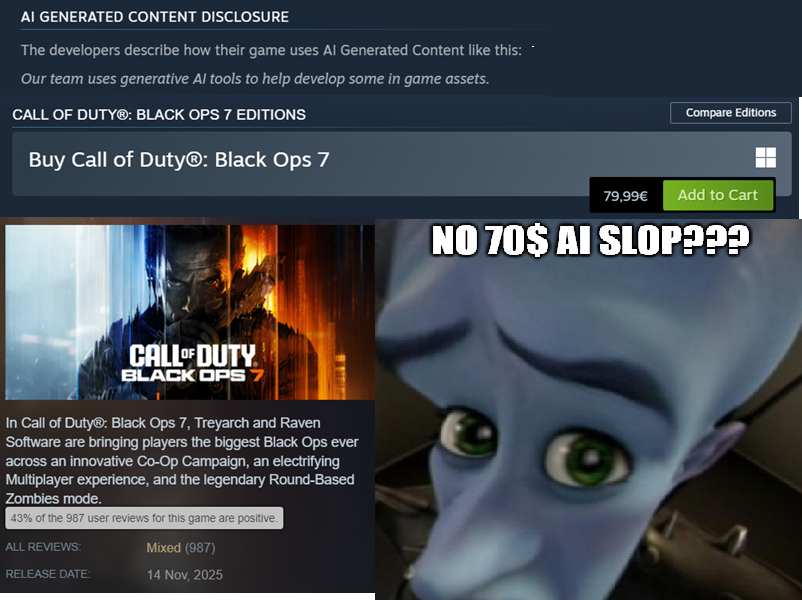
The gaming industry's latest AI disclosure is peak irony. The game proudly announces "Our team uses generative AI tools to help develop some in game assets" while charging €79.99 for the privilege. Meanwhile, the shocked alien face perfectly captures what we're all thinking: "NO 70$ AI SLOP???" It's the perfect storm of modern gaming: charging premium prices for content partially created by AI, while having the audacity to brag about it in the marketing. And that 43% positive review score? *Chef's kiss* The perfect garnish on this AI-generated disappointment platter. Notice the 2025 release date too - we're literally paying top dollar to beta test tomorrow's AI experiments. The future of gaming is here, and it costs exactly €79.99!

NordVPN

NordVPN
Encrypt your traffic on public Wi-Fi, stream from anywhere, and cover up to ten devices with one plan. 30-day money-back guarantee.

Capitalism: The Most Honest Game Tag

Capitalism: The Most Honest Game Tag
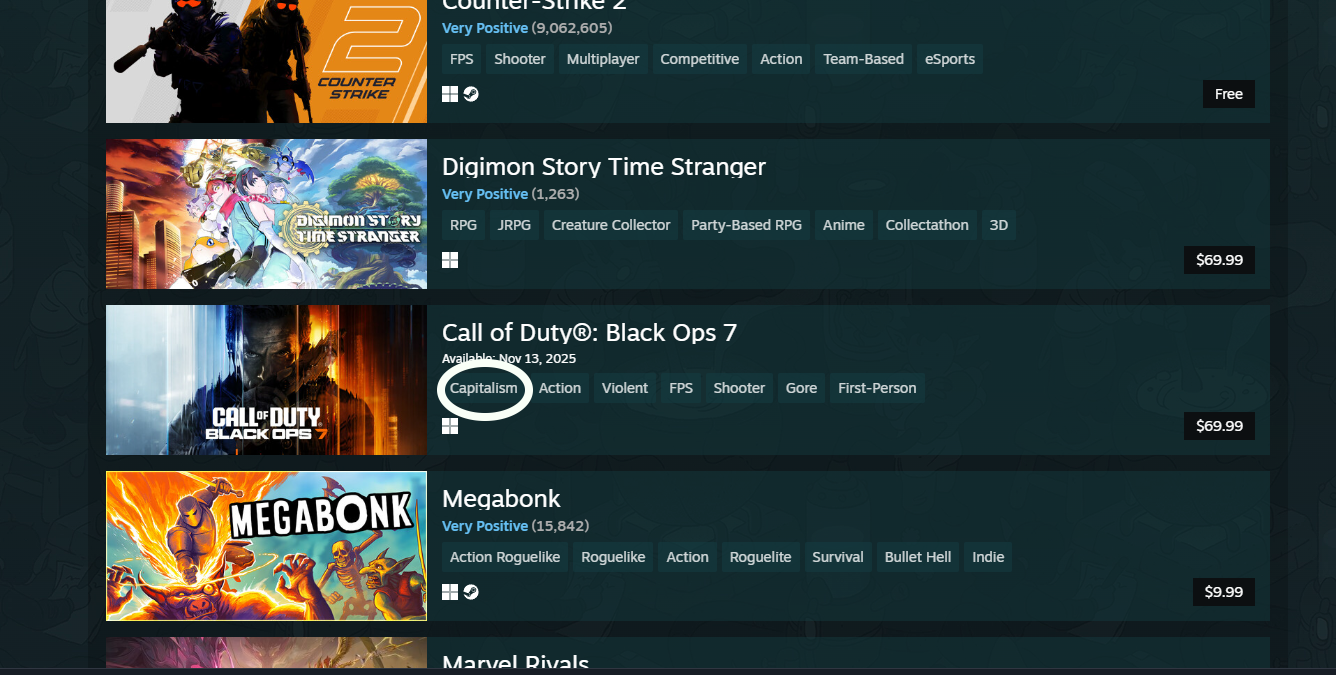
That "Capitalism" tag on Call of Duty is hitting harder than a critical exception in production code. Nothing says "authentic gaming experience" like paying $69.99 for the privilege of being reminded that you're participating in the very system that designed the microtransaction hellscape you're about to enter. It's like when your code comments itself with // This is going to hurt later and you ship it anyway.

Still Better Than Pirating My Game, I Guess

Still Better Than Pirating My Game, I Guess
The eternal emotional rollercoaster of indie game development. Left panel: "Oh look, someone's actually paying for my game that took 3 years to make!" Right panel: "...and they got it for $1 during a Steam sale, so I'll make approximately enough to buy half a cup of coffee." That feeling when your passion project becomes a financial rounding error. But hey, at least they didn't torrent it.