Function parameters Memes

Posts tagged with Function parameters
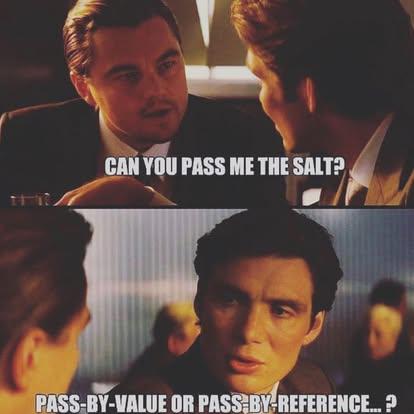
Dinner With A Programmer Is Never Simple

Dinner With A Programmer Is Never Simple
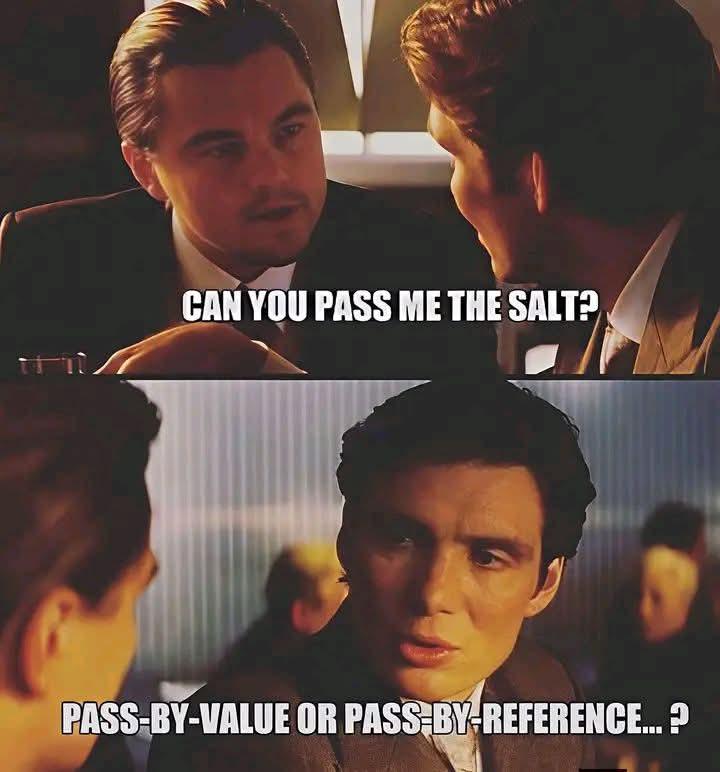
Someone innocently asks for the salt at dinner, and the programmer's brain immediately goes into technical specification mode. "Do you want me to hand you the salt shaker itself, or just point to where it is so you can grab it yourself?" Pass-by-value means you get a copy of the salt (the actual shaker), while pass-by-reference means you get directions to the salt's memory address on the table. The poor person just wanted to season their food, but now they're stuck in a function parameter debate. We literally cannot turn off the optimization brain. Even at dinner. Especially at dinner. The worst part? We genuinely think we're being helpful by asking for clarification.

They Put So Many Params In Function Definition

They Put So Many Params In Function Definition
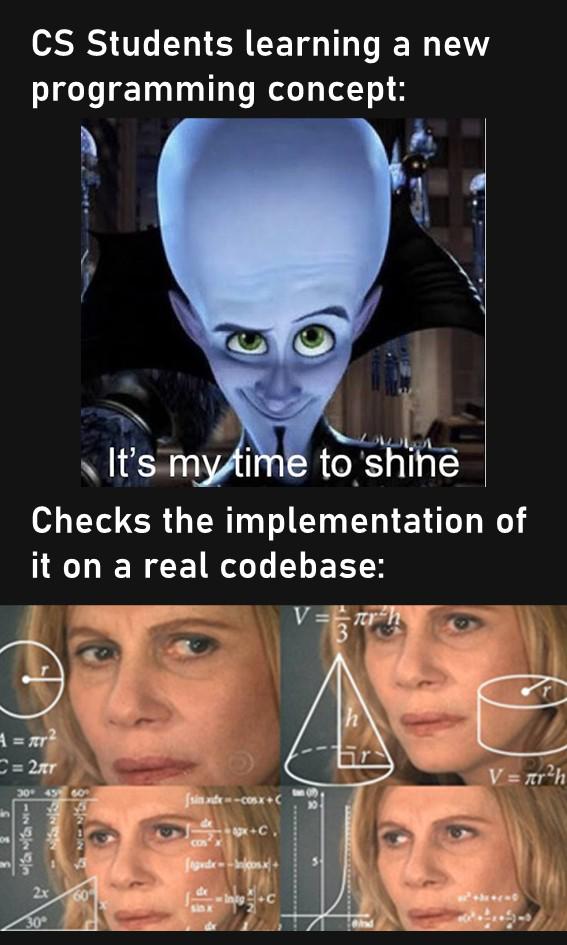
You know that feeling when your professor explains a function with like 2-3 parameters and you're sitting there all confident like Megamind ready to conquer the world? Then you open the actual production codebase and BAM—you're staring at a function signature that looks like someone's entire grocery list had a baby with a config file. Suddenly you're doing advanced calculus just to figure out which parameter does what, because OF COURSE none of them have descriptive names and the documentation is from 2014. The transition from "I understand functions!" to "what fresh hell is this" has never been more violently accurate.

If You Know You Know

If You Know You Know
The eternal question that separates the juniors from the seniors. Someone innocently asks you to pass the salt, and suddenly your brain is running a full stack trace on whether they want a copy of the salt shaker or just a pointer to its memory address. Pass-by-value means they get their own little salt shaker (a copy), so whatever they do with it doesn't affect yours. Pass-by-reference means you're handing them the actual salt shaker, and if they dump it all over their food, well, you're both out of salt now. This is why programmers can't have normal dinner conversations. We're too busy worrying about memory allocation and whether we need to implement a mutex lock on the condiments.

Can't Have It Short And Also Missing Character

Can't Have It Short And Also Missing Character
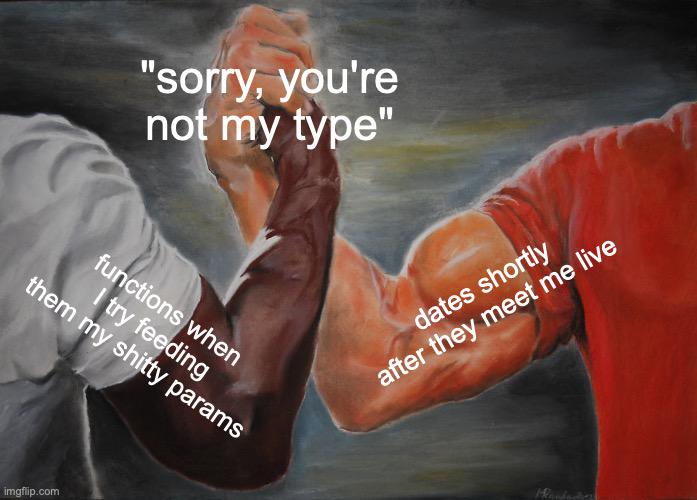
Oh the AUDACITY! You want your functions to be clean, readable, and self-documenting with proper parameter names? Well TOUGH LUCK because the dates package decided to go full minimalist mode and name everything like they're texting on a flip phone from 2003. But the MOMENT you try to feed it some actual shorthand notation, it throws a tantrum like "sorry sweetie, you're not my type" 💅 The absolute DRAMA of trying to validate dates with strict parameters while simultaneously dealing with cryptic abbreviated format strings. It's giving "I want my cake and eat it too" energy, except the cake is type safety and the eating is... well, also type safety. Choose your poison: either write "my_stinky_params" that look like a toddler named them, OR embrace the chaos of shorthand that the library won't even recognize. There is no middle ground, only suffering.

The UUID Inception Function

The UUID Inception Function
Ah, the elegant art of naming variables. This function has achieved peak redundancy with a UUID parameter named uuid of type UUID that returns a UUID containing a UUID with the value uuid. It's like saying "I'd like to order an order of ordered orders, please." The compiler is probably in therapy now.

Pass Me The Salt... But How?

Pass Me The Salt... But How?
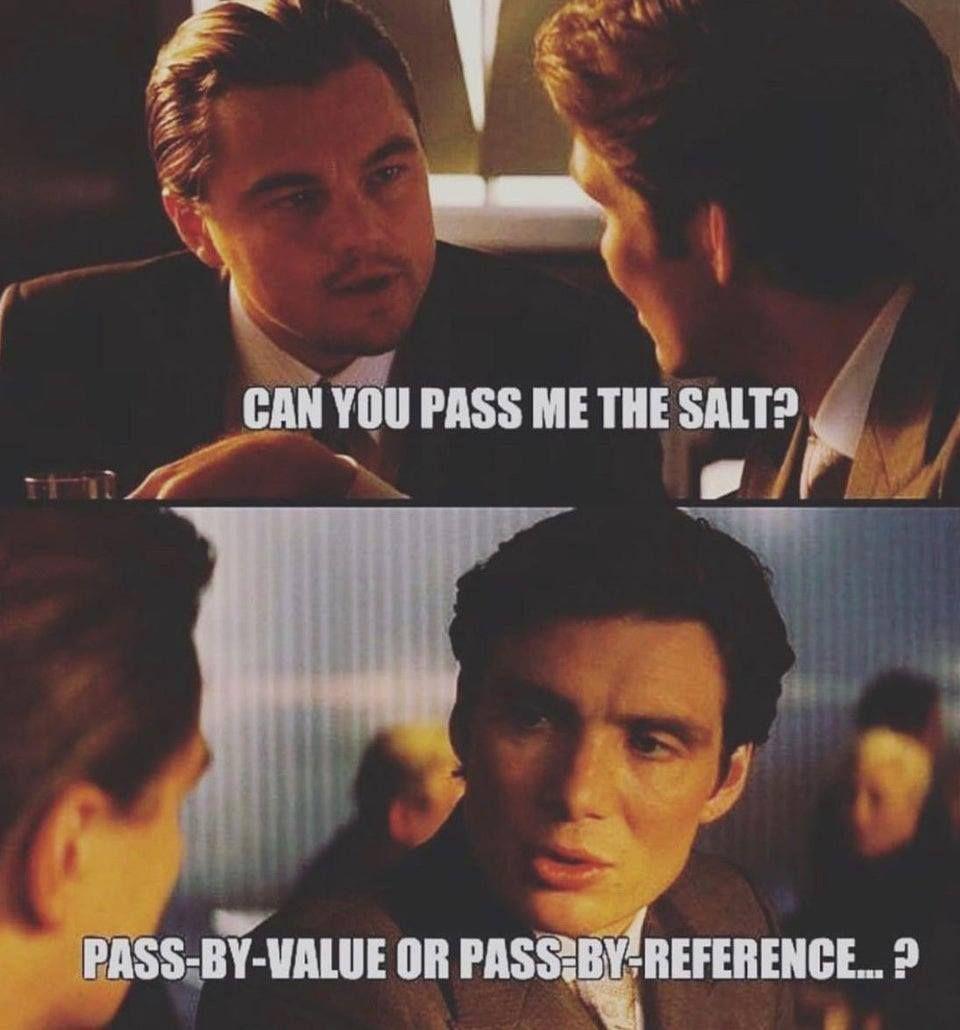
That moment when even dinner conversations turn into technical debates. Normal people ask for salt, but programmers immediately need to know the implementation details. Pass-by-value makes a copy (enjoy your own salt shaker), while pass-by-reference just hands you the original (here, use mine). Ten years into coding and I still overthink simple interactions like this. The real question is whether the salt has immutable properties...

Not Enough Parameters Gang

Not Enough Parameters Gang
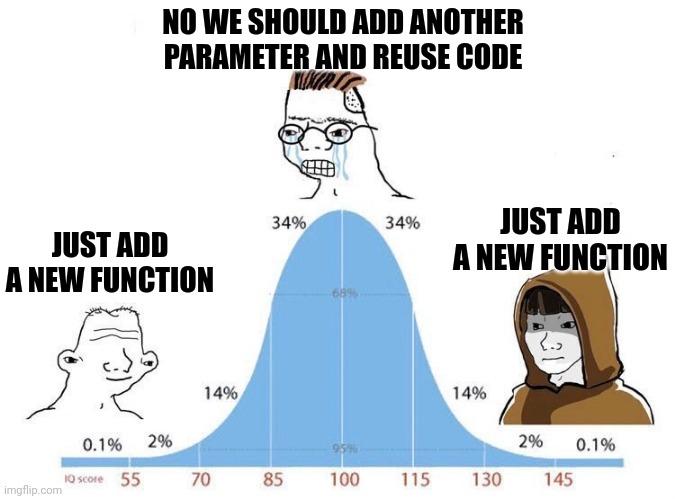
The eternal dilemma of function design perfectly illustrated on an IQ bell curve. The low-IQ crowd (0.1%) and high-IQ geniuses (0.1%) agree: "Just add a new function." Meanwhile, the average devs (34%) in the middle are sweating bullets, desperately clinging to their sacred principle of code reuse: "NO WE SHOULD ADD ANOTHER PARAMETER AND REUSE CODE!" It's the horseshoe theory of programming - both extremes of the intelligence spectrum somehow reach the same conclusion while the "well-actually" crowd in the middle is busy creating those monstrous functions with 17 optional parameters, 9 of which are booleans. And they wonder why nobody wants to maintain their code...

NordVPN

NordVPN
Encrypt your traffic on public Wi-Fi, stream from anywhere, and cover up to ten devices with one plan. 30-day money-back guarantee.

Some Things ̶N̶E̶V̶E̶R̶ ̶C̶H̶A̶N̶G̶E̶ ̶ Change For The...

Some Things ̶N̶E̶V̶E̶R̶ ̶C̶H̶A̶N̶G̶E̶ ̶ Change For The...
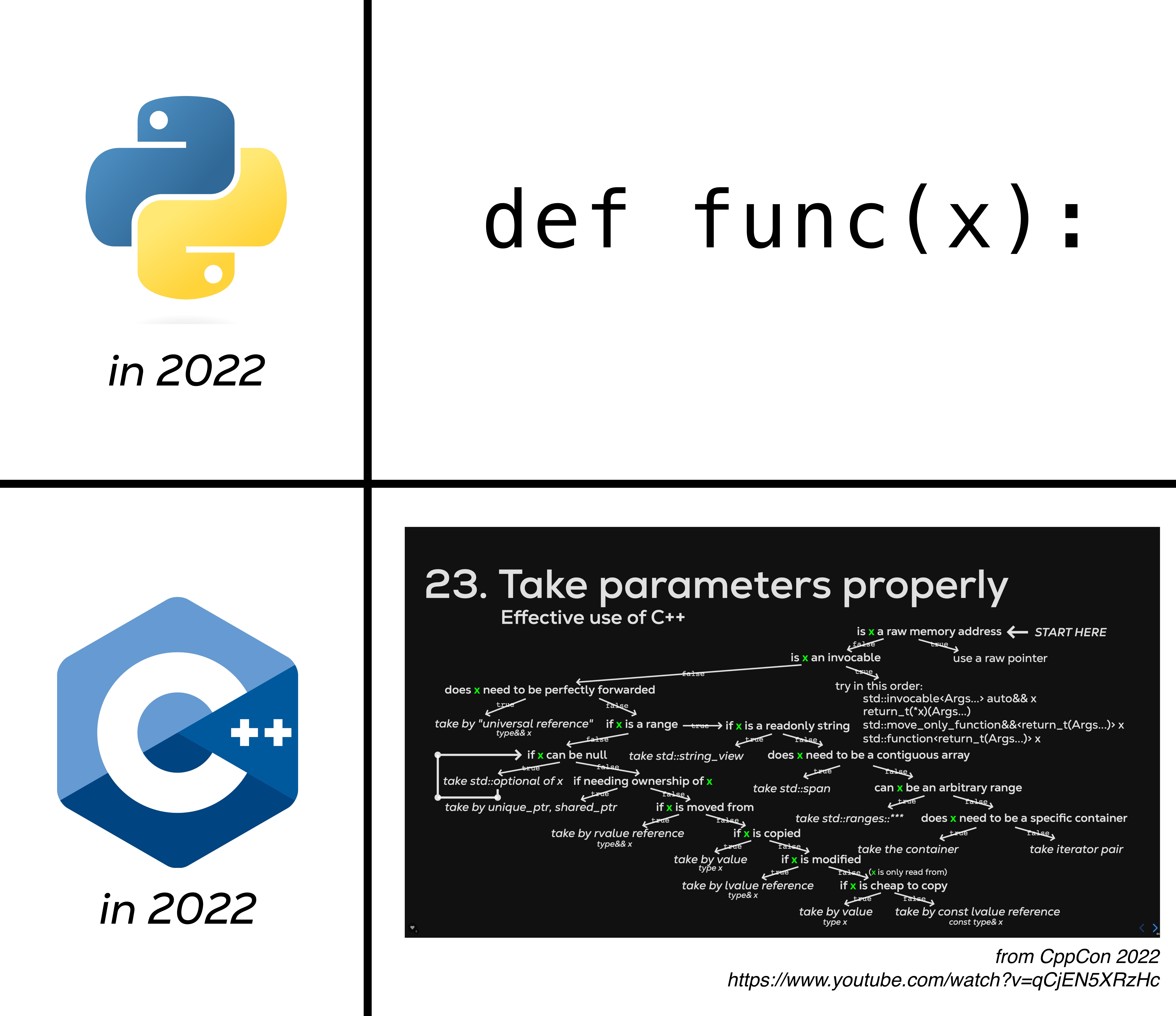
Python vs C++ in 2022: a tale of two worlds. Left side: Python's blissful simplicity. def func(x): - that's it. You're good to go. Ship it. Right side: C++'s parameter passing flowchart that looks like someone mapped the human genome. "Is x a raw memory address?" "Is x invocable?" "Does x need to be perfectly forwarded?" Just to figure out how to pass a damn variable. Remember when we thought languages would get simpler over time? Yeah, that was cute. Meanwhile C++ developers are over here with decision trees that would make air traffic controllers nervous.

Good Foxy Day To You! Here Is A Fubuki Meme

Good Foxy Day To You! Here Is A Fubuki Meme
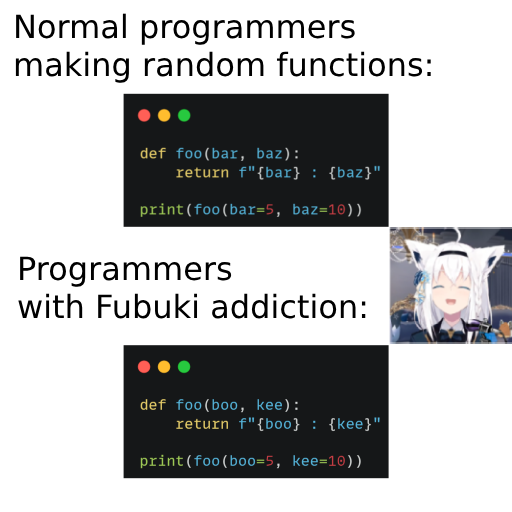
Ah, the subtle art of variable naming! The code is identical, but the parameters tell the whole story. Regular programmers use boring old bar and baz - the placeholder variables straight from the CS textbook. But those cultured individuals with a Fubuki addiction? They've ascended to boo and kee - because why write functional code when you can inject your VTuber obsession into every line? The function still works exactly the same, but now your code review buddies know EXACTLY what you were watching instead of fixing those bugs. Priorities, people!