

Theoretical cs Memes

Posts tagged with Theoretical cs
Seems Trivial

Seems Trivial
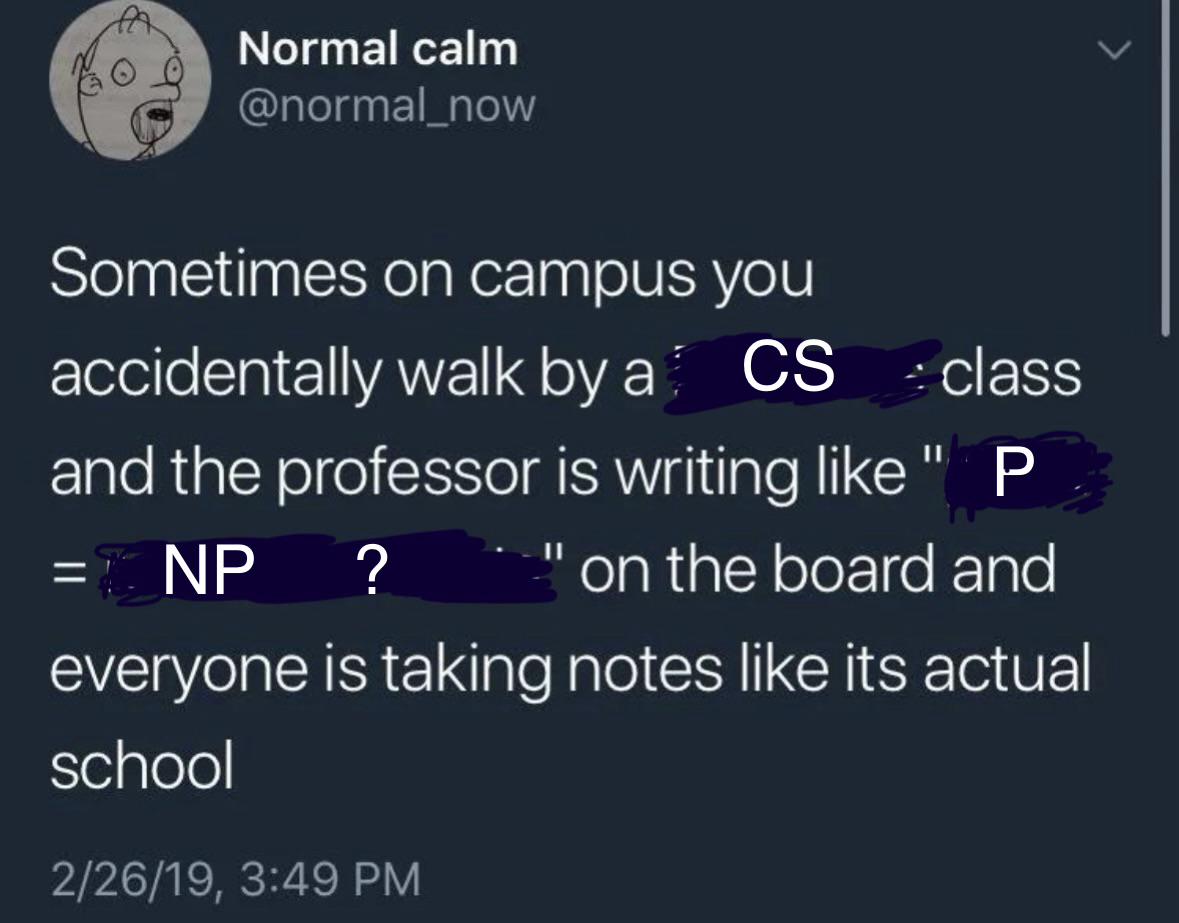
You're just walking past a CS classroom when you catch a glimpse of the professor casually scribbling "P = NP ?" on the board. The entire class is frantically taking notes like it's some routine homework problem. Meanwhile, you're standing there knowing this is literally one of the seven Millennium Prize Problems with a $1 million bounty from the Clay Mathematics Institute. For context: P vs NP is one of the most important unsolved problems in computer science and mathematics. If P = NP, it would mean every problem whose solution can be quickly verified can also be quickly solved—which would revolutionize cryptography, optimization, and basically break the internet as we know it. Mathematicians have been wrestling with this for decades. So either this professor just solved the most significant problem in computational complexity theory during office hours, or those students are about to be very confused when they realize their "trivial proof" has a slight flaw.

Now We Are Talking

Now We Are Talking
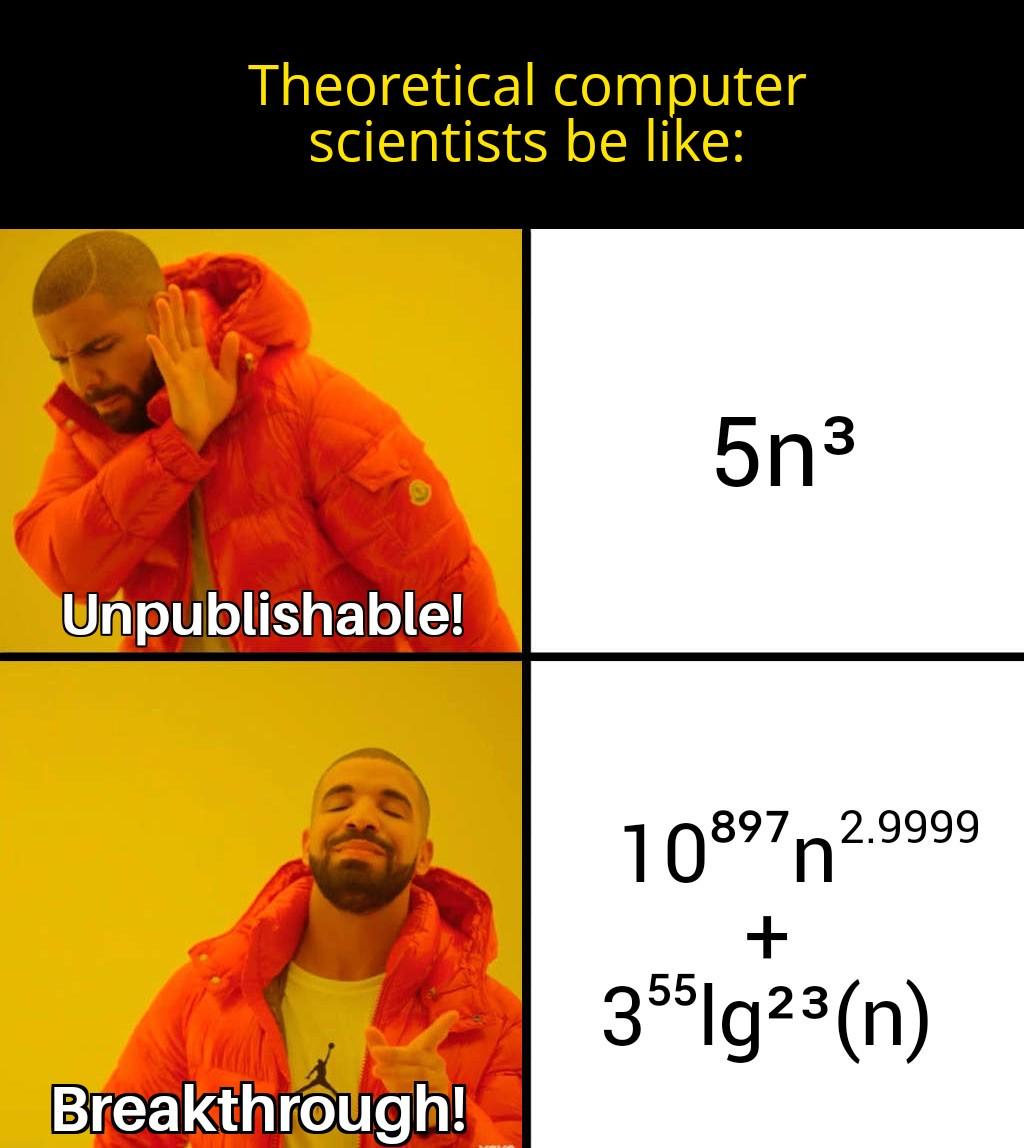
When your algorithm goes from O(n³) polynomial time to O(10⁸⁹⁷n²·⁹⁹⁹⁹ + 3⁵⁵lg²³(n)), theoretical CS folks suddenly think you've achieved something groundbreaking. Because nothing screams "publishable research" like taking a simple cubic complexity and turning it into an absolute monstrosity of exponential and logarithmic terms that would make your CPU weep. Sure, O(n³) is "unpublishable" because it's too straightforward, but slap on some ridiculous exponents and suddenly you're conference-paper material. The best part? Both are probably still slower than just using a hash map.

Theoretical Computer Science

Theoretical Computer Science
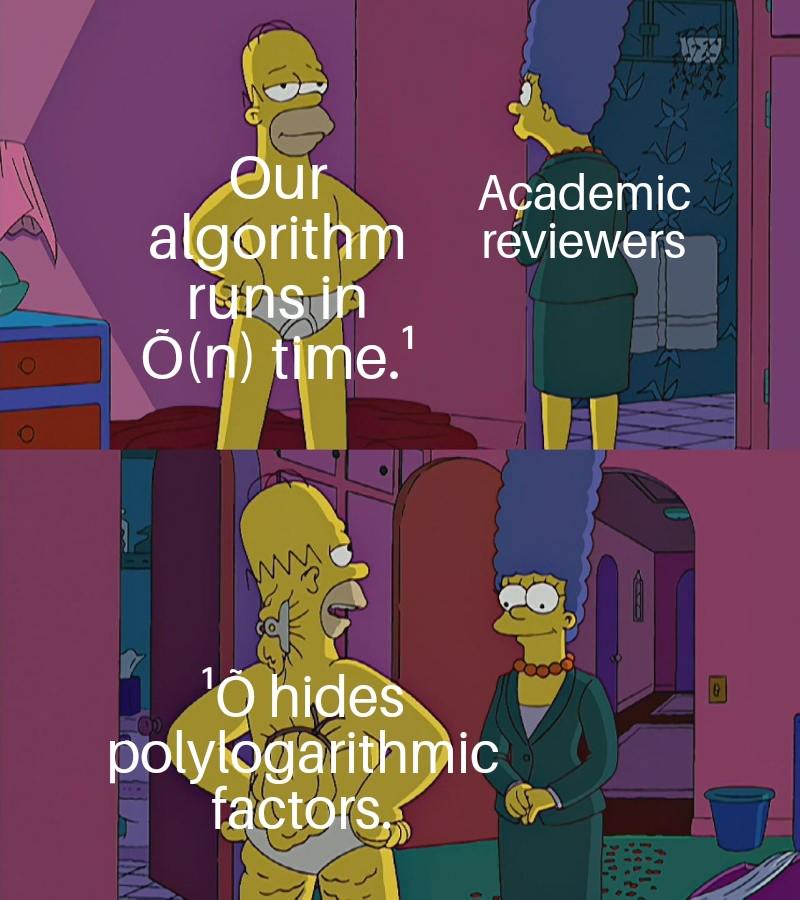
Oh, the beautiful dance of academic deception! You waltz into your paper review claiming your algorithm runs in O(n) time—linear, elegant, *chef's kiss*—and the reviewers are nodding approvingly. Meanwhile, hidden in the mathematical bushes like a sneaky little gremlin, there's a polylogarithmic factor just CHILLING there. You know, those innocent-looking log(n) terms that technically don't change the Big-O notation but absolutely DO change whether your algorithm is actually practical or just theoretically pretty. It's like saying "yeah my car goes 60mph!" while conveniently forgetting to mention it only does that while rolling downhill with a tailwind. Technically O(n log n) is still O(n) when you squint hard enough and ignore constants, but your algorithm is about as fast as Homer's brain processing Marge's disappointment.

For Theoretical Computer Scientists

For Theoretical Computer Scientists
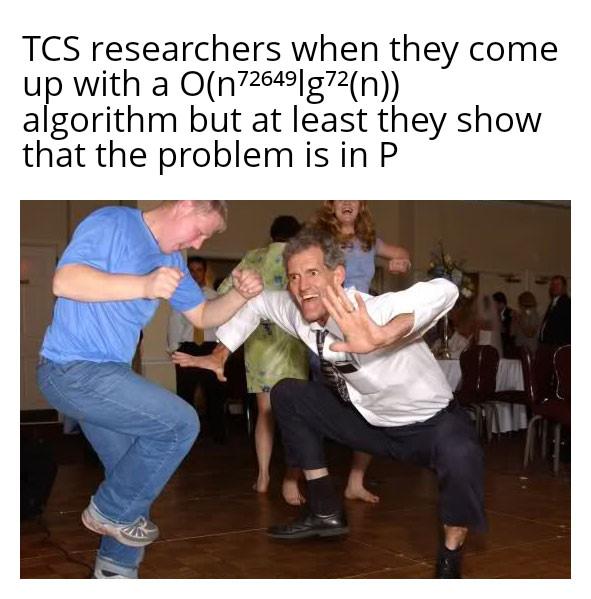
Theoretical computer scientists really out here creating algorithms with time complexity that looks like someone smashed their keyboard while having a seizure—O(n 72649 lg 72 (n))—and then celebrating like they just won the lottery because "hey, at least it's polynomial time!" The P vs NP problem has these folks so desperate for wins that proving something is solvable in polynomial time (even if that polynomial makes the heat death of the universe look quick) is cause for celebration. Sure, your algorithm would take longer than the age of the universe to sort a deck of cards, but technically it's in P, so break out the champagne! It's like saying "I can walk to Mars" and when everyone looks at you skeptically, you add "well, it's theoretically possible!" Meanwhile, us practical programmers are over here optimizing O(n log n) to O(n) and actually shipping products.

Will Halt Trust Me Bro

Will Halt Trust Me Bro
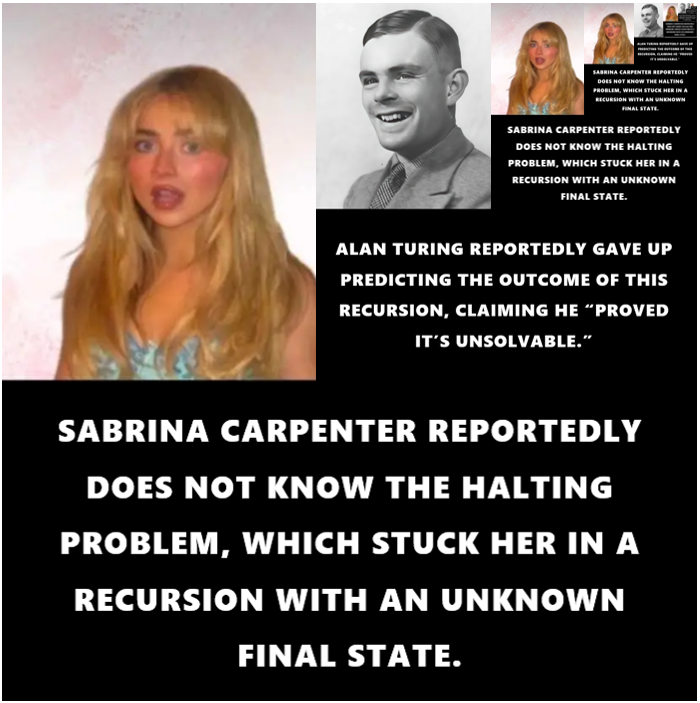
Imagine writing a recursive function and promising your boss it'll finish eventually. Spoiler alert: Alan Turing is laughing in his grave. For the uninitiated, the Halting Problem is basically computer science's way of saying "some programs are like that friend who says they'll be ready in 5 minutes." It's mathematically impossible to create an algorithm that can determine whether any arbitrary program will eventually terminate or run forever. So next time your code is stuck in an infinite loop, just tell your project manager it's not a bug—it's a fundamental limitation of computational theory. You're not incompetent, you're just bumping into the boundaries of mathematics itself!

NordVPN

NordVPN
Encrypt your traffic on public Wi-Fi, stream from anywhere, and cover up to ten devices with one plan. 30-day money-back guarantee.

The Halting Problem Doesn't Want Us To Know

The Halting Problem Doesn't Want Us To Know
The classic "chocolate gorilla melting in milk" meme perfectly encapsulates the frustration of dealing with the Halting Problem in computer science. Just as the gorilla dissolves before finishing his sentence, any algorithm attempting to determine if another program will terminate (halt) or run forever is doomed to fail. Alan Turing mathematically proved this is impossible in 1936. Yet here we are, still trying to debug infinite loops and recursion bugs like we're going to outsmart fundamental computational theory. Spoiler alert: we won't, but we'll keep trying anyway because deadlines.

Just Had This On An Interview

Just Had This On An Interview
They really asked the candidate to solve the Halting Problem during an interview! That's like asking someone to divide by zero or find the last digit of pi. The interviewer might as well have said, "Please disprove this fundamental theorem of computer science before lunch." For the uninitiated: The Halting Problem was proven mathematically impossible to solve by Alan Turing in 1936. It's literally asking if you can write a program that can determine whether any arbitrary program will terminate or run forever. Computer scientists have known for decades this is impossible in the general case. The interviewer might as well have asked "Could you quickly build me a perpetual motion machine while you're at it?"

The Bogosort Dimension

The Bogosort Dimension
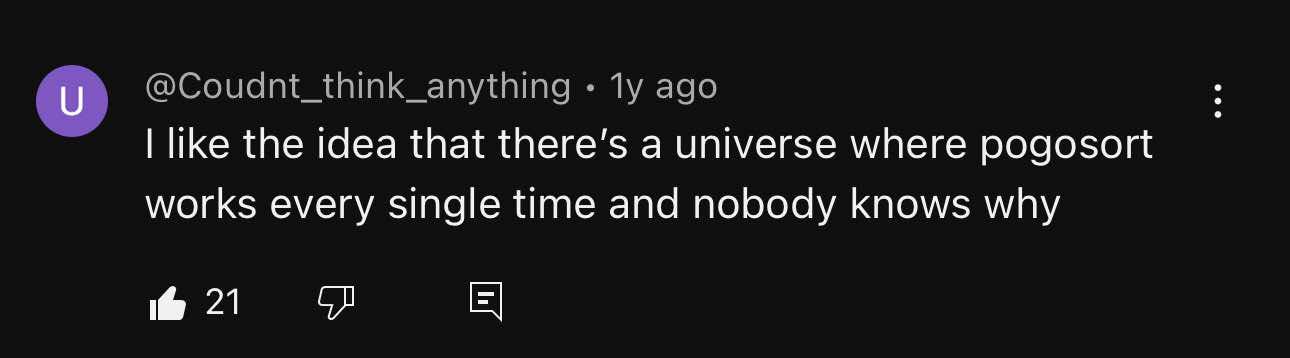
Ah, the mythical parallel universe where bogosort—the algorithm equivalent of throwing a deck of cards in the air and hoping they land in order—actually works reliably. In our dimension, this disaster of an O(n×n!) algorithm would take longer than the heat death of the universe to sort your Netflix queue. But somewhere out there, developers are using it in production and getting promotions while we're stuck optimizing quicksort like suckers.

Formal Languages: Where Logic Goes To Cry

Formal Languages: Where Logic Goes To Cry
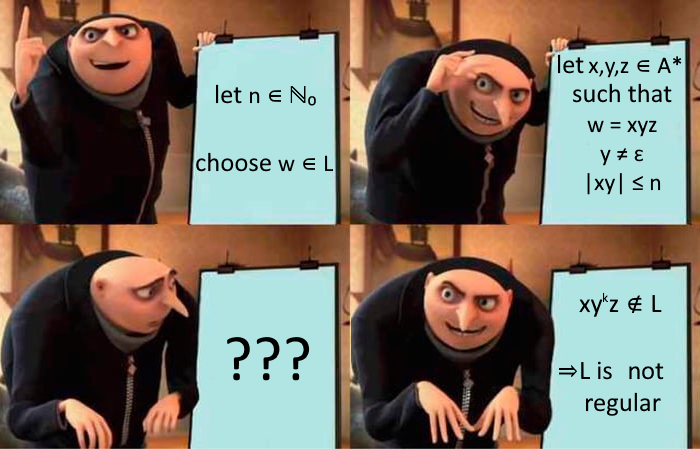
Computer science theory professors be like: "It's so obvious, just follow along!" Then they hit you with formal language proofs that make calculus look like kindergarten arithmetic. The meme shows the classic "Gru's Plan" format but with formal language theory notation. Gru confidently sets up variables and constraints, then has that moment of confusion when he realizes he's just proven the language isn't regular - which is probably the opposite of what he was trying to prove. For the uninitiated: formal language theory is where computer scientists torture themselves by proving properties of languages using mathematical notation that looks like someone face-planted on a keyboard. Regular languages are the simplest type in the Chomsky hierarchy, and proving a language is not regular is a rite of passage that makes students question their life choices.

This Works In Theory

This Works In Theory
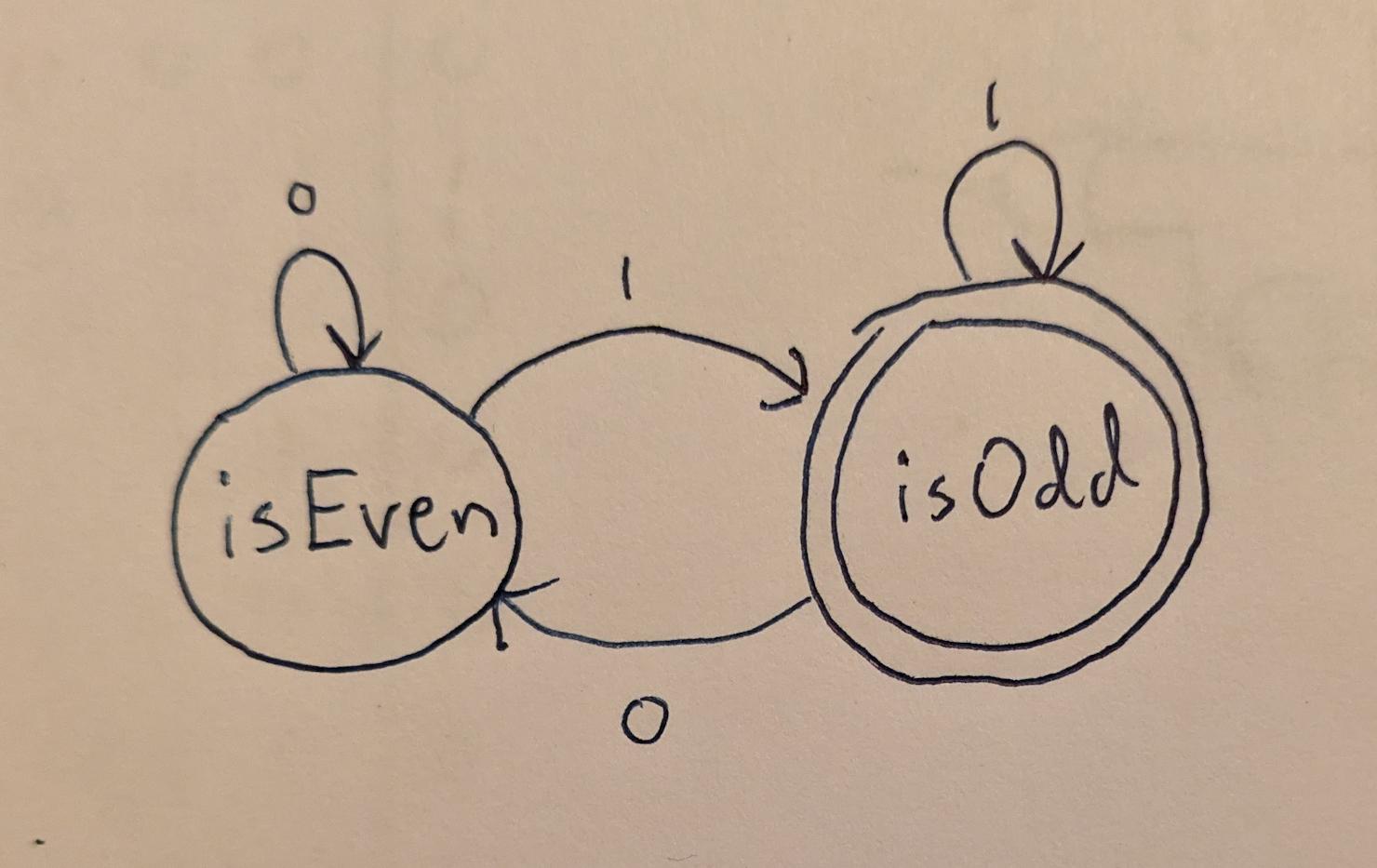
The eternal struggle between theory and reality, illustrated with the elegance of a napkin sketch. What we have here is a linked list implementation of a number classifier that would make computer science professors proud and working developers cry. Sure, in theory, you can determine if a number is odd or even by traversing a linked list where each node points to its opposite classification. Start at "isEven" with 0, follow the pointer once for 1 to get "isOdd", twice for 2 to get back to "isEven"... mathematically sound! Meanwhile, in the real world, the rest of us are just using n % 2 == 0 like normal people and going home at 5pm instead of debugging infinite loops when someone inputs 18,446,744,073,709,551,615.